Chrome Web Extension
 Edge Web Extension
 Android App
 iOS App


Doomscrolling usually starts in a familiar way. You check your phone late at night for one update. Then one post turns into ten. A bad headline becomes a thread, then a comment fight, then a video, then another post that makes your chest tighten a little. You tell yourself you are just catching up, staying informed, making sure you did not miss anything important. Then you look at the time and realize far more of your night is gone than you meant to give away.
That emotional pattern is part of why doomscrolling feels so sticky. Curiosity pulls you in. Anxiety keeps you there. A short burst of relief arrives when you find a post that seems to explain what is happening, but that relief rarely lasts. The feed gives you one more thing to react to, one more thing to check, one more reason not to stop.
That endless scroll is not just a habit. It is a business model. The longer you scroll, the more valuable you become.
What is doomscrolling (and why is it so hard to stop)
Doomscrolling is the repeated habit of scrolling through upsetting, stressful, or negative content, especially on social media and news-heavy feeds. Researchers have described it as persistent attention to negative information in feeds about crises, disasters, and other distressing events, and they have linked it with anxiety, poor self-control, passive social media use, and fear of missing out.
Part of the trap comes from negativity bias. Human attention is naturally drawn toward possible threats. Your brain would rather overreact to bad news than miss something important. In a social feed, that means alarming headlines, angry posts, conflict clips, and fear-heavy commentary can pull stronger reactions than neutral updates or ordinary daily content.
That is why doomscrolling can feel oddly productive even when it leaves you drained. Negative news creates the feeling that you are staying informed or staying prepared. But what often happens is not clarity. It is repeated exposure to emotionally loaded fragments that keep your attention activated without giving you a satisfying stopping point.
There is also the dopamine loop, a reward system layered on top of the stress. Even when the content feels bad, checking again can still create a small hit of anticipation. Maybe the next post will explain everything. Maybe the next reply will make the story make sense. Maybe the next update will be better. That uncertainty keeps the hand moving.
So the contradiction sits right in the middle of the experience. It feels bad, but it is hard to stop. You do not leave the feed feeling better, yet you keep checking because the design keeps offering another cue, another alert, another reason to stay.
Why social media platforms encourage doomscrolling
Social platforms do not make money because you feel better after using them. They make money by holding attention long enough to show more ads, gather more behavioral signals, and improve ad targeting.
That is the simplest way to understand the system. More time spent in the feed usually means more ad impressions. More ad impressions usually mean more revenue opportunities. More scrolling also gives the platform more information about what catches your attention, what you pause on, what you skip, what you tap, and what emotional tone keeps you engaged.
This is why engagement-based revenue influences the feed so strongly. The algorithm is not built around your well-being. It is built around signals that suggest you will stay longer, react more, and come back again. Scientific American’s take if social media is addictive summarized this plainly: never-ending feeds, autoplay, and revenue-driven recommendation systems keep people going, and experts argue that platforms benefit from holding user attention.
That also helps explain the outrage premium. Fear, anger, conflict, and shock tend to keep people watching more than neutral posts do. Platforms do not need to sit a user down and say, “Here is upsetting content because it earns more.” They only need ranking systems that keep promoting the kinds of posts that produce stronger reactions and longer sessions. If the content that performs best is emotionally charged, the system keeps feeding more of it.
Doomscrolling is not a bug. It is a feature of the system.
The role of ads in the doomscrolling cycle
Ads do not sit beside doomscrolling as a separate issue. They are woven into it.
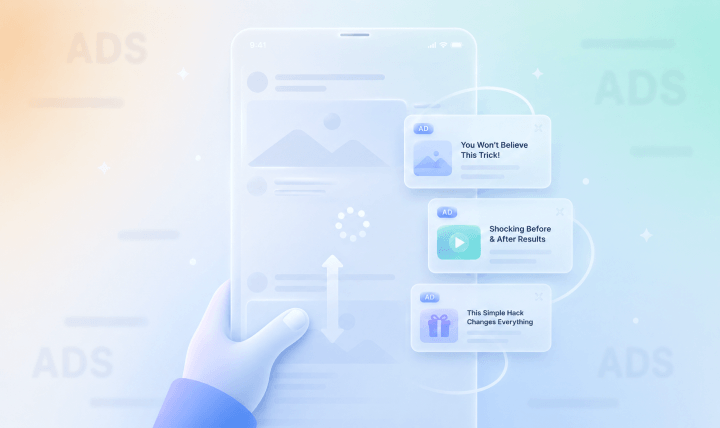
In social feeds, ads are placed directly between posts, replies, clips, and recommendations. On Facebook, Instagram, X, and LinkedIn, sponsored content often arrives in the same visual rhythm as the rest of the feed. That means the user is not moving between “content mode” and “ad mode.” Everything arrives inside one continuous stream.
Negative content is the bait. Ads are the monetization engine.
Native ads make this stronger because they often resemble ordinary posts at a glance. You are already in a reactive state, already scanning quickly, already emotionally activated. In that condition, an ad can work as an attention reset, a curiosity trigger, or an emotional amplifier. It interrupts the previous post, but it does not fully break the session. It gives the feed a fresh prompt and keeps the thumb moving.
This becomes even more significant because doomscrolling often creates an extended, vulnerable state. When someone has been scrolling for a while, especially late at night or while feeling stressed, they are not browsing with much intention but rather reacting. That gives the platform more chances to expose them to ads and more chances to learn from what they do next.
The longer the session runs, the more precise the targeting can become. A user who lingers on posts about burnout, layoffs, conflict, parenting worries, productivity guilt, or health fears is handing the platform a stream of behavioral clues. The ads shown during or after that session are already guided by signals gathered during that scrolling behavior and don’t just appear randomly.
Infinite scroll + ads = no escape
Older media had built-in stopping cues. A newspaper page ended. A TV segment cut to something else. Even early web pages had a bottom. What’s different with social feeds is that they removed that structure.
Infinite scroll means there is no natural stopping point, only more content loaded beneath the last item. A 2026 research update from the ADDICT project also reinforces this point. It examined addictive design strategies on social media and highlighted features such as infinite scroll, autoplay, ads, and notifications as mechanisms that can encourage compulsive use patterns and keep users in the feed longer.
That design choice has a big psychological effect. When there is no clear endpoint, stopping becomes a personal discipline problem instead of a product structure. The platform does not help you pause. It waits for you to do all the work.
Ads fit neatly into that design. They are inserted between content pieces so the stream never needs to break. A stressful post is followed by a sponsored post. Then another update. Then another ad. Then a suggested account. Then a thread. The feed keeps changing just enough to prevent boredom, but not enough to create a clean exit.
There is no moment to pause, only more content, and more ads.
Once ads blend into the same rhythm as posts, they start to feel like part of the feed itself. That is one reason the experience can feel so slippery. You are moving through a mixed stream designed to keep attention alive and monetize it at the same time.
Why this feels so draining
The exhaustion is not just about “too much screen time.” It comes from the way the system stacks stress on top of interruption.
Emotional overload from negative content
If a feed keeps serving conflict, disaster, outrage, fear, or social comparison, your nervous system stays activated. Even when you know the content is not helping, the repeated exposure adds up. Doomscrolling research has linked the behavior with anxiety, and newer work continues to find positive associations between doomscrolling and anxiety in different contexts.
Cognitive fatigue from constant switching
The feed constantly switches your attention between posts, comments, clips, headlines, sponsored messages, suggested accounts, and notifications. That repeated switching is tiring on its own. Add ads into the middle of it, and the experience becomes even more fragmented.
Loss of intentional control
You may open an app to check one message or one update, but after a while you are no longer choosing what to see in any meaningful way. You are reacting to what is fed to you.
That is why doomscrolling often leaves people feeling both overstimulated and oddly empty. You spent attention, emotion, and time, but you did not get much back besides more agitation and more prompts to continue.
Use Poper Blocker to break the cycle on social media
If ads help fuel the doomscrolling experience, removing them can change the texture of the feed.
Poper Blocker can block ads and sponsored content on Facebook, Instagram, X, and LinkedIn to create a more distraction-free browsing experience across social platforms.
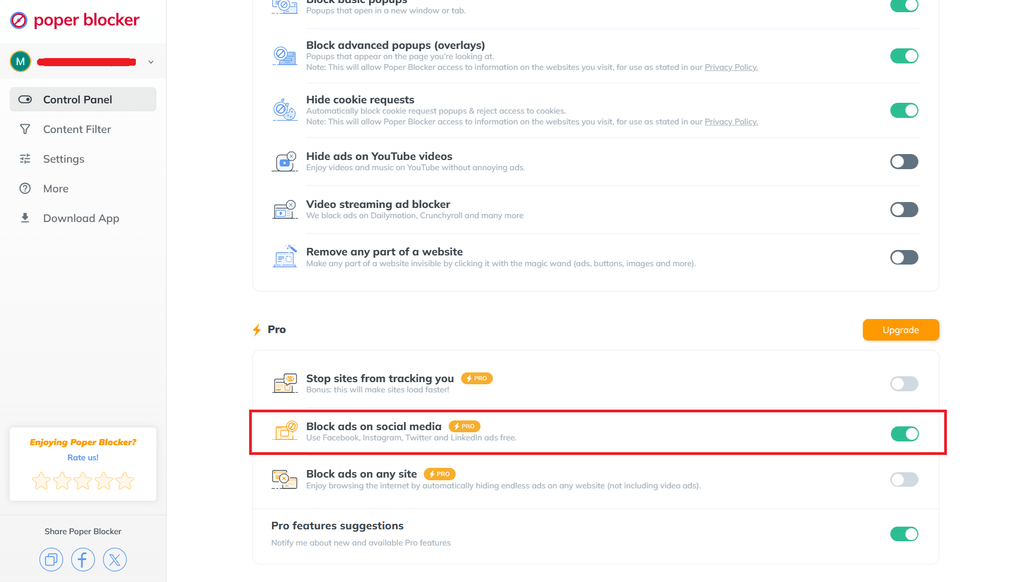
So what does that change in everyday use?
- It removes interruptions from the feed. When sponsored posts disappear, there are fewer sudden prompts competing for your attention.
- It cuts down on attention hijacking. Ads are built to interrupt, tempt, provoke, and redirect. Fewer of them means fewer artificial pulls inside a session.
- It can make scrolling less addictive. Not because one tool magically fixes doomscrolling, but because removing feed-level ad triggers can reduce some of the cues that keep the session going.
Fewer ads can also mean fewer moments where the platform tries to convert your emotional state into a click, a view, or a purchase. That matters when you are already tired, stressed, or browsing on autopilot.
When ads disappear, the scroll loses some of its grip. You are no longer being pulled as often. You have more room to choose.
That is the useful way to think about ad blocking here. It is not only about cleaning up the screen. It is about regaining control over attention in an environment built to keep taking it.
Get more control over your feed
Doomscrolling and ads are deeply connected because they serve the same attention economy. One keeps you in the feed. The other turns that time into money.
That does not mean you need to quit social media altogether or treat every platform like an enemy. Many people use these apps for work, updates, community, and entertainment. The issue is not that scrolling exists. It’s that the system is built to keep extending it, especially when emotional content and sponsored content are working together.
Small changes can shift the experience more than people expect. Removing ads will not solve every digital well-being problem, but it can reduce interruptions, cut down on triggers, and make the feed feel less engineered against you.
Start by changing what you allow into your feed.
FAQ
What is doomscrolling in simple terms?
Doomscrolling is the habit of repeatedly scrolling through upsetting or negative posts, even when the experience leaves you stressed or tired. It often feels like staying informed, but it can quickly turn into compulsive checking.
Why do social media apps make doomscrolling easy?
Because endless feeds, engagement-based ranking, and ad-driven business models all reward longer sessions. The more time people spend in the feed, the more chances platforms have to show ads and gather behavioral signals.
Are ads part of the doomscrolling problem?
Yes. Ads are not just sitting next to the experience. They are built into the feed and often blend with organic posts. That helps keep attention moving while turning long sessions into ad revenue and better targeting data.
Does removing ads stop doomscrolling completely?
No. Doomscrolling is also driven by habit, stress, curiosity, and platform design. But reducing ads can remove some of the extra triggers and interruptions that keep a scrolling session going longer than intended.
Can Poper Blocker remove ads from social media feeds?
Yes. Poper Blocker can remove ads and sponsored content on Facebook, Instagram, X, and LinkedIn, while also blocking ads across websites more broadly.